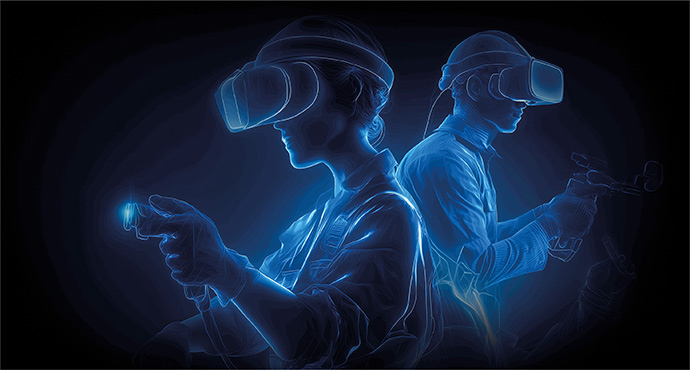
Effective training is a major challenge for organisations. Traditional training formats often show their limits when dealing with complex, technical or high-stakes operational content. The "Train differently" offering aims to transform training programmes into immersive, engaging and lasting experiences, leveraging virtual reality (VR), augmented reality (AR), interactive 3D and innovative pedagogical approaches such as serious games.
The goal is twofold: improve learning effectiveness while sustainably capitalising on internal knowledge and expertise.
Why rethink training formats?
Today’s learners face information overload and significant time constraints. In this context, capturing attention and fostering retention becomes a challenge. Immersive training puts the learner back at the centre of the process, by having them experience real-life situations rather than passively receiving top-down content.
Experiential learning promotes understanding, long-term retention and the ability to react in real situations. This is particularly true for technical, industrial or high-risk professions, where hands-on practice is essential.

Virtual reality (VR) training: learning without risk
Virtual reality training immerses the learner in a simulated, realistic and safe environment. It offers the ability to reproduce complex, dangerous or costly situations that would be difficult to set up in the real world. Learners can practise, make mistakes, try again and progress without any impact on people, equipment or infrastructure.
VR is particularly suited to training in technical gestures, critical procedures, safety and maintenance. It also helps standardise training while ensuring a consistent experience for all learners.
Augmented reality (AR) and 3D: learning as close to the field as possible
Augmented reality enriches training by overlaying digital information onto the real world or by manipulating virtual objects. This technology is ideal for supporting learners directly in the field, during maintenance, assembly or diagnostic operations.
AR provides step-by-step guidance, displays contextual information and reduces errors.
Interactive 3D, in turn, facilitates the understanding of complex, invisible or hard-to-access systems, making mechanisms more readable and representative through PC or mobile interfaces.

Custom pedagogical solutions
Every training project is unique. We design custom pedagogical solutions, tailored to the objectives, audiences and constraints of each organisation. Formats can be immersive, hybrid or complementary to existing training programmes.
Our approach is based on rigorous instructional design: defining learning objectives, scripting learning paths, selecting appropriate technologies and designing user-centred experiences. The challenge is to deliver training that is useful, engaging and truly operational.
Capitalising on knowledge and securing its transfer
Beyond one-off training, the "Train and capitalise" offering aims to preserve and pass on the organisation’s key skills. Immersive experiences help formalise often tacit know-how, held by experts or experienced employees.
This capitalisation is essential in contexts of generational renewal, skills shortages or evolving professions. It ensures knowledge continuity and faster upskilling of new recruits.
Measuring impact and improving learning paths
Immersive solutions enable the collection of valuable pedagogical data: progression, success rates, frequent errors and time spent. These indicators facilitate training management, continuous content improvement and the assessment of actual impact on skills.
Training thus becomes a measurable, scalable tool aligned with the organisation’s operational challenges.

Gamification in the service of pedagogical effectiveness
Gamification plays a key role in the effectiveness of immersive training. By integrating game mechanics (progressive objectives, challenges, immediate feedback, progress indicators, symbolic rewards), it strengthens learner engagement and maintains motivation throughout the journey. Gamification encourages active participation, promotes the repetition of gestures or decisions and significantly improves content retention. It transforms the learner into an active participant in their own training, reduces dropout rates and facilitates the grasp of complex concepts, particularly in technical or high-stakes environments. Used thoughtfully, gamification becomes a powerful pedagogical lever for embedding skills durably and improving training performance.
Who is the Train and capitalise offering for?
This offering is aimed at companies, training centres, educational organisations, local authorities and industrial structures facing challenges in technical training, safety or knowledge transfer. It is particularly relevant for high-stakes sectors (industry, energy, defence, infrastructure, healthcare), as well as training, HR and innovation departments looking to modernise their programmes.
More engaging, more effective and lasting training
By combining VR, AR, 3D, serious games and immersive pedagogy, the "Train and capitalise" offering transforms training into a genuine performance driver. It improves learner engagement, secures learning outcomes and sustainably enhances skills within organisations.
Go further: Discover our detailed VR / AR training offering.
Go further: Discover our detailed VR / AR training offering for training centres.
